Showing posts with label Computing. Show all posts

The Architecture of Open Source Applications

  • 0
I'm in the middle of designing a new architecture for scientific applications and came across this "mine". Just had a pic, but looks something to add to my bookshelf.

Like the authors say:  Developers "repeat one another's mistakes rather than building on one another's successes." (Where have I heard this before?).

Topics discussed for roughly 50 applications:

  • How open source applications are structured, and why. 
  • What are each program's major components? 
  • How do they interact? 
  • And what did their builders learn during their development?


Link: http://www.aosabook.org/en/index.html

isocpp.org: C++ unifying website.

  • 0
In the talk below Herb Sutter give an update on recent progress and near-future directions for C++. One of the remarkable points to retain is the new C++ unifying website:

http://www.isocpp.org/


A fantastic source of information for C++ programmers.

PDF MetaData Gui editor in Ubuntu?

  • 0
I used to use pdftk to edit the PDF metadata of my PDFs before sending them to my Kindle.

Just googled for a GUI to use in Ubuntu and came across to this "made in France" application: gnome-pdf-tool.
Binaries not available for the Ubuntu 12.04 but works pretty well just out of the box.


The big advantage is that you don't have to export the metadata to a text file, edit them and then import them back.

The World's #1 Open Science Supercomputer

  • 0

Titan will be the first major supercomputing system to utilize a hybrid architecture, or one that utilizes both conventional 16-core AMD Opteron CPUs and unconventional NVIDIA Kepler graphics processing units (GPUs).


Introducing Titan | The World's #1 Open Science Supercomputer

The Research Software Engineer

  • 0

“Software engineering professionals are trained in best practices [...] Attempts to leverage these skills within academia by employing contract programmers typically fail [...] Software engineers that do have research experience [...] are, however, in very short supply, due to the lack of appropriate institutional homes and career progression paths for their work.”
Original articles:

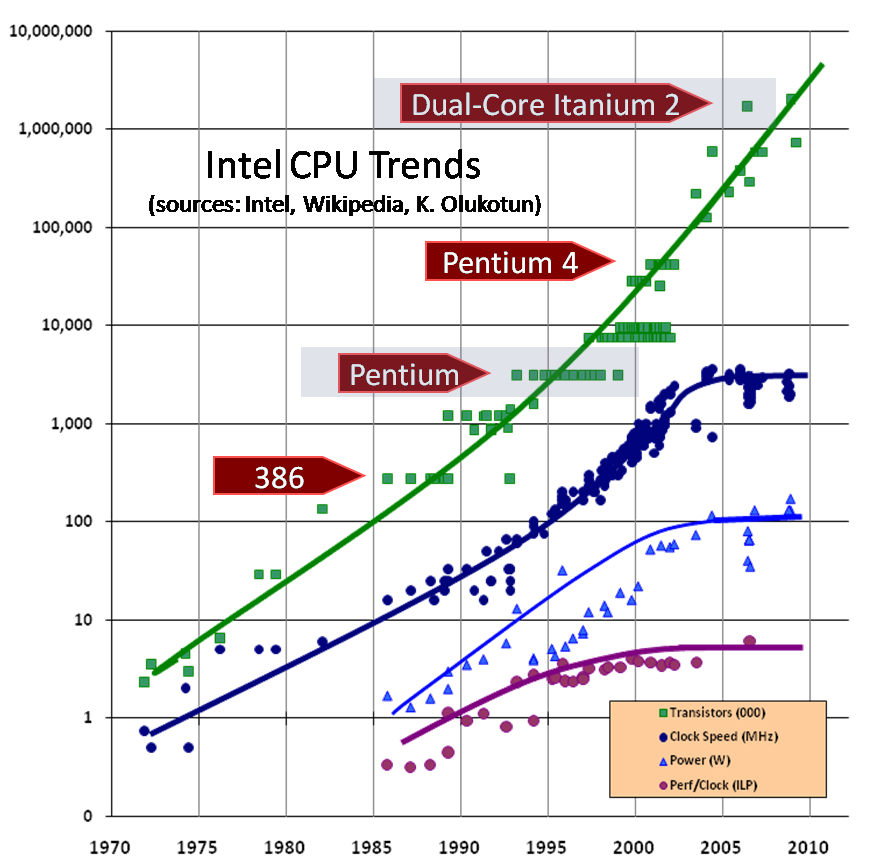
CPUs evolution...

  • 0
Number of cores has increased but clock speed hit the wall around 2003 (physics!).

Concurrency is the key for the future. Given the limited life charge of the Smartphones and tablets' batteries, efficient programming languages are and will be the key. Time to (re-)learn C++.
(Trying to convince my self tough....)